

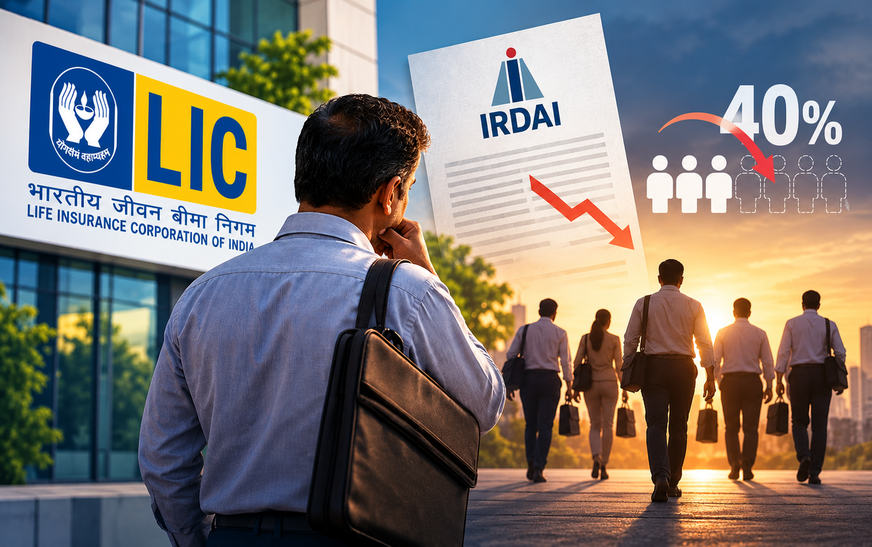
For decades, the friendly neighbourhood LIC agent has been the backbone of insurance in India. Long before digital comparison portals and instant policy apps, it was an agent sitting across the living room table—explaining terms over a cup of tea—who convinced millions of families to secure their financial future.
Today, however, that traditional agency model is staring at a major shake-up.
As the Insurance Regulatory and Development Authority of India (IRDAI) proposes tighter caps on commissions and distribution expenses, industry veterans are sounding the alarm. While the regulator’s goal is noble—lowering costs for policyholders and curbing mis-selling—the unintended consequence could be a massive exodus of the very people who keep the industry moving.
A Looming Exodus: 15% to 40% Attrition?
According to industry stalwarts, the proposed overhaul doesn’t just trim the fat; it cuts close to the bone for everyday agents.
Vipin Anand, former Managing Director of LIC, estimates that roughly 15% of LIC agents could exit the profession over the next two years. While he notes that this wave would mostly consist of part-time agents or newcomers—accounting for about 1% to 2% of LIC’s total business—it signals a worrying drop in the attractiveness of the role.
N. Gajapathi Rao, Chairman (Organisation, IRDAI & Political Affairs) at the Life Insurance Agents Federation of India (LIAFI), paints an even starker picture. Looking at a three-to-four-year horizon, Rao warns that agent attrition could climb as high as 40% if stringent measures like commission clawbacks are introduced.
“People like us who have 30 or 40 years of service in LIC cannot leave till our death, because there is no alternative for us. But if stringent actions such as clawbacks are introduced, people will not be encouraged to join the profession, and people will definitely leave.” — N. Gajapathi Rao, LIAFI
Beyond the Headline Rate: The Hidden Cost of Selling a Policy
On paper, a 20% or 25% commission rate might sound generous to an outsider. Look beneath the surface, however, and the math changes quickly.
What many policy frameworks overlook is the sheer legwork required to close a single life insurance sale. Insurance isn’t an impulse buy; it is a long-term financial commitment that requires trust, education, and persistence.
- The 10-to-1 Reality: As Vipin Anand points out, an agent typically has to pitch to at least 10 prospects just to get one “yes.” Even then, converting that single customer often takes four or more follow-up visits.
- Out-of-Pocket Expenses: Rao highlights that knocking on a prospect’s door five, 10, or even 20 times requires significant time, travel, and personal expense—costs that agents bear entirely on their own before seeing a single rupee of commission.
- The Incentive Squeeze: Under IRDAI’s proposed consultation paper, the cap doesn’t just apply to base commissions; it bundles in non-commission incentives like rewards, travel benefits, and marketing support. To keep the agency model viable, Anand suggests allowing insurers an extra 10% buffer above commission limits specifically for incentives and marketing expenses.
The Silver Lining for LIC: A Boost in Bancassurance?
Interestingly, tighter commission rules aren’t entirely bad news for LIC as a corporation. In fact, Anand believes the curbs could inadvertently help the state-owned giant reclaim market share in the bancassurance channel (selling insurance through bank branches).
Historically, private insurers have often outpaced LIC in banks by offering heavier incentives to bank partners. If IRDAI levels the playing field by capping those payouts across the board, bank staff will have less financial bias toward private players. Given the natural trust Indian consumers already place in the LIC brand, policies could become much easier to sell at bank counters.
The Bigger Picture: Fixing Mis-Selling Without Breaking the Agent
Even if LIC gains ground in banks, the long-term question remains: Who will bring in the next generation of policyholders?
Young professionals are already hesitant to view insurance agency as a stable, respected career path compared to fields like law, medicine, or chartered accountancy. Squeezing earnings and threatening clawbacks when a customer stops paying premiums—often due to the customer’s own financial hardship rather than agent malpractice—only makes recruitment harder.
Both veterans agree on one critical point: capping commissions is not a silver bullet for mis-selling.
True reform requires holding insurers accountable for their product design and conduct, improving branch efficiency, boosting policyholder bonuses, and penalising deliberate fraud rather than punishing honest fieldwork.
Final Thoughts
Lowering distribution costs and protecting consumers are essential goals for a maturing insurance market. However, in a country where insurance still has to be nudged, explained, and sold person-to-person, the human network cannot be treated as an afterthought.
As IRDAI finalises its framework, the challenge will be finding the sweet spot: delivering better value to the policyholder while ensuring that the person knocking on doors can still make an honest, sustainable living.