


Japanese businesses are showing growing interest in cyber insurance as a series of high-profile cyberattacks highlights the financial and operational risks associated with inadequate cybersecurity protection.
Recent incidents involving major Japanese companies have disrupted business services, exposed sensitive information and raised concerns about the potential cost of recovering from cyberattacks.
The developments are drawing greater attention to insurance products designed to help businesses manage certain financial consequences of cyber incidents.
According to a report published by The Japan Times on 2 November 2026, the number of cyber insurance contracts held by nine providers increased from 74,852 in fiscal 2020 to 344,930 in fiscal 2025, which ended in March 2026.
That represents approximately 4.6 times the earlier contract count.
Separate reporting by Nikkei Asia has also highlighted increasing enquiries about cyber insurance among Japanese non-life insurers, although the precise scale of that recent increase remains unverified.
Together, the reports point to growing business awareness of cyber risks and the potential role of insurance in managing them.
Cyber insurance contracts grow more than fourfold
The expansion in cyber insurance contracts reflects a notable change in how businesses are approaching digital risks.
Cyber incidents can affect companies of different sizes and across industries, creating financial exposures that extend beyond the immediate cost of repairing compromised systems.
A significant attack can interrupt business operations, prevent access to essential technology, expose customer information and trigger legal or contractual obligations.
The resulting expenses can include technical investigations, recovery operations, legal assistance, customer notifications and potential liability claims.
For some businesses, lost revenue from interrupted operations may be an additional concern.
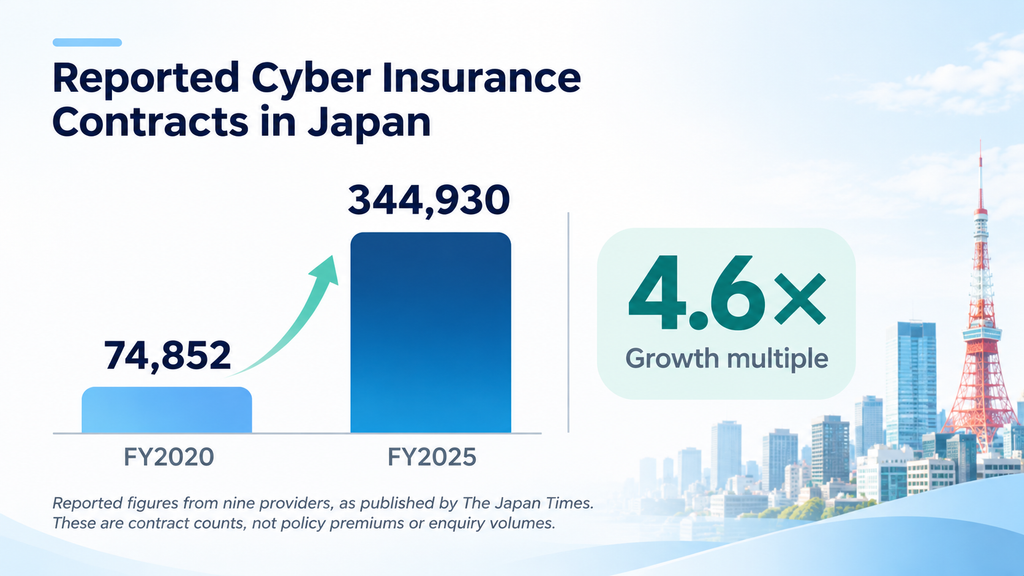
The increase is significant, but it should not be interpreted as the growth rate of the entire Japanese cyber insurance market without knowing the complete market coverage of the reported dataset.
It also does not indicate how much premium revenue insurers earned or how much cyber risk is adequately insured.
Recent cyberattacks strengthen business concerns
The growing interest in cyber insurance comes against a backdrop of serious cybersecurity incidents affecting Japanese organisations.
One prominent example involves GMO Internet Group, which disclosed unauthorised access affecting services associated with foreign exchange trading.
Reports in late October indicated that the incident had potentially affected thousands of customer servers and accounts, raising concerns about compromised information and unauthorised transactions.
GMO announced measures to compensate affected customers and address the security weaknesses associated with the incident.
Other Japanese companies, including Asahi Group Holdings and Askul, have also experienced cyber incidents that disrupted operations.
These cases show how cyberattacks can create consequences beyond the theft of information.
A company may need to suspend services, restore systems, investigate the incident, communicate with customers and absorb substantial recovery costs.
For businesses dependent on digital platforms, even a relatively short interruption can affect revenue and customer relationships.
Such incidents provide a practical reason for companies to reassess their cybersecurity arrangements and consider whether their insurance protection is sufficient.
What does cyber insurance actually cover?
Cyber insurance is designed to provide financial protection against specified losses arising from cyber incidents.
Depending on the policy wording, coverage may include several types of expenses.
Incident response and forensic investigation
Policies may cover costs associated with investigating the source of a cyber incident, identifying compromised systems and determining the extent of damage.
Data breach response
Some policies provide protection for expenses related to notifying affected customers, obtaining legal advice and managing certain liabilities arising from data breaches.
Business interruption
Cyber insurance may compensate eligible financial losses when a covered cyber incident interrupts business operations.
The applicable waiting periods, loss calculations and coverage limits are important considerations.
System restoration and recovery
Certain products may cover expenses incurred in recovering affected data, restoring systems and resuming business services.
Cyber extortion and ransomware
Some policies include specified cyber extortion expenses, subject to insurer approval, exclusions and legal restrictions.
These benefits are not universal.
Coverage differs between insurers and can be affected by policy exclusions, deductibles, sublimits, security requirements and other contractual conditions.
Businesses should therefore assess policies based on the risks they face rather than assuming that every cyber incident will be covered.
What rising demand means for Japanese insurers
Increasing awareness of cyber insurance presents an opportunity for Japan’s non-life insurance industry.
Companies seeking protection against cyber-related financial losses may create additional demand for specialised insurance products, risk assessment services and advisory support.
However, cyber insurance also presents underwriting challenges.
Unlike many conventional insurance risks, a single cyber vulnerability can affect numerous organisations at the same time.
Businesses may rely on the same cloud provider, software platform or technology infrastructure. A major failure or compromise affecting those shared services could generate losses across multiple insured companies.
Insurers must therefore consider not only the cyber risk of individual policyholders but also the potential accumulation of losses across their portfolios.
As more companies seek coverage, underwriting may involve closer examination of cybersecurity practices, backup arrangements, access controls and incident response capabilities.
These considerations influence how insurers assess risk, structure coverage and determine appropriate terms.
It remains uncertain whether the recent wave of incidents will lead to sustained changes in Japanese cyber insurance pricing or underwriting conditions.
Cyber insurance does not replace cybersecurity
While cyber insurance can help businesses manage certain financial consequences of an incident, it does not prevent an attack from occurring.
Companies still need effective security measures to reduce the likelihood and severity of cyber incidents.
These may include access controls, regular software updates, employee awareness programmes, secure data backups and tested incident response procedures.
Insurance and cybersecurity therefore serve complementary purposes.
Security measures aim to prevent incidents and limit their impact, while insurance can help address specified financial losses when a covered event occurs.
For insurance buyers, understanding this distinction is essential.
A policy should be assessed alongside the organisation’s overall risk management strategy, taking account of the systems, data and operations most critical to the business.
Opportunities and challenges for the Japanese market
Japan’s cyber insurance market may have room for further expansion as organisations become more conscious of the financial consequences of cyber incidents.
An October 2026 report from insurance market intelligence provider Axco identified cyber insurance among the areas offering growth opportunities in Japan’s non-life insurance sector.
Small and medium-sized businesses could represent an important segment of this market.
These organisations may depend heavily on digital systems while having fewer internal resources to manage complex cyber incidents.
For insurers and brokers, explaining coverage in practical terms could help businesses understand the protection available and its limitations.
At the same time, effective underwriting and claims management will remain important as cyber threats evolve.
Expanding insurance availability without adequately assessing exposure could create challenges for insurers facing increasingly complex and interconnected cyber risks.
What comes next for Japan’s cyber insurance market?
The increase in cyber insurance contracts over recent years suggests that more Japanese businesses are recognising cyber incidents as financial risks requiring attention.
Recent high-profile attacks may reinforce that awareness, although the extent to which they translate into additional policy purchases remains to be established.
Future market developments will depend on factors such as cyberattack frequency, business demand, insurance pricing, available coverage and insurers’ willingness to accept emerging risks.
For businesses, the priority is not simply purchasing cyber insurance but understanding what protection is available and how it fits alongside cybersecurity and business continuity planning.
For insurers and brokers, the challenge will be to meet growing interest while maintaining clear coverage terms, disciplined underwriting and effective support when policyholders experience cyber incidents.