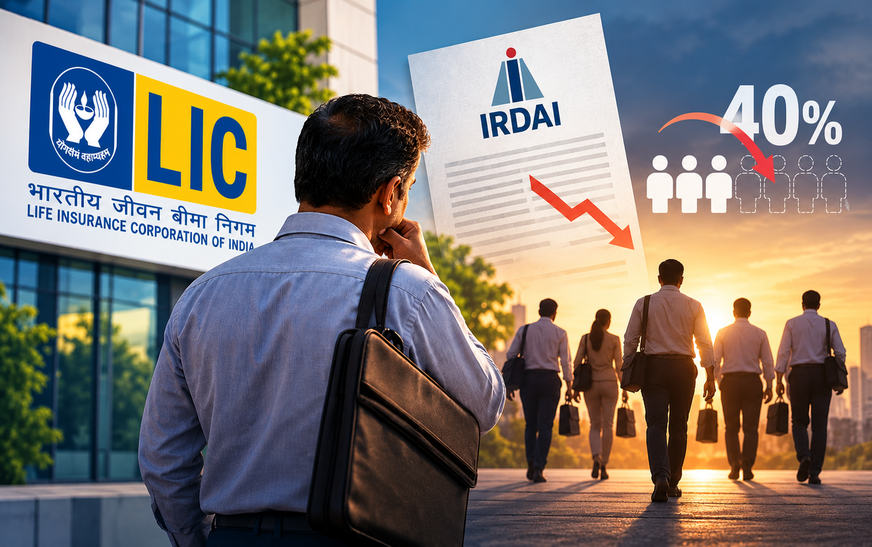


The Insurance Regulatory and Development Authority of India (IRDAI) has declared November 2026 as Grievance Resolution Month, launching an industry-wide effort to accelerate the resolution of longstanding insurance complaints and disputes.
Announced on 29 October 2026, the initiative seeks to encourage insurance companies to review unresolved grievances, prioritise older disputes and pursue fair settlements wherever legally and factually appropriate.
The move follows concerns over the substantial number of insurance-related cases pending before consumer commissions, judicial courts and other dispute resolution forums.
According to figures reported by the regulator, approximately 2.21 lakh cases were pending before consumer commissions and judicial courts as of 31 March 2026. Of these, 72.49% had remained unresolved for more than a year.
Separately, approximately 11 lakh cases were reportedly pending before Motor Accident Claims Tribunals (MACTs).
Beyond reducing the backlog, IRDAI wants insurers to address the underlying causes of complaints and improve the overall experience of policyholders.
Insurance dispute backlog raises concerns
The volume of unresolved insurance disputes highlights a significant challenge for India’s insurance industry.
Insurance is designed to provide financial protection against unexpected events. However, when claims remain disputed for extended periods, policyholders may face financial pressure, uncertainty and additional legal expenses.
Delays can be especially difficult for families depending on life insurance benefits, individuals seeking reimbursement for medical treatment and accident victims awaiting compensation.
The reported backlog illustrates the scale of the problem.
Insurance dispute backlog as of 31 March 2026
2.21 lakh
Pending consumer commission and court cases
72.49%
Of those cases pending over one year
11 lakh
Reported pending MACT cases
The figures relate to different legal forums and should not be treated as one combined measure of ordinary insurance complaints.
Consumer commissions and judicial courts hear a range of disputes involving insurance providers, while MACTs deal specifically with compensation claims arising from motor vehicle accidents.
The numbers nevertheless underline the importance of improving both grievance handling and the management of disputes that have already reached legal proceedings.
IRDAI Grievance Resolution Month 2026: What insurers have been asked to do
As part of the November initiative, IRDAI has advised insurance companies to examine pending grievances and identify matters that can be resolved without unnecessary further delays.
The regulator’s reported recommendations cover several areas.
- Prioritising older disputes: Insurers are encouraged to give greater attention to complaints and cases that have remained pending for extended periods.
- Reviewing ongoing litigation: Companies should assess pending legal matters on their merits and explore amicable settlements where appropriate.
- Complying with Ombudsman awards: Insurers have been advised to implement Insurance Ombudsman decisions promptly.
- Accelerating resolution across forums: Complaints pending through other grievance channels should receive attention.
- Improving litigation management: Insurers should strengthen internal processes to reduce avoidable delays.
- Addressing recurring complaints: Companies are encouraged to identify common causes of disputes and introduce corrective and preventive measures.
These steps aim to encourage insurers to deal more effectively with unresolved matters while reducing the likelihood of similar disputes arising in future.
Importantly, the initiative should not be interpreted as requiring insurers to settle every disputed claim regardless of its merits.
Why meaningful grievance resolution matters
Resolving an insurance grievance involves more than recording a complaint as closed.
A case may be administratively closed without fully addressing the policyholder’s concern. Similarly, repeated correspondence or procedural delays can leave customers uncertain about whether their complaint has been properly examined.
IRDAI’s initiative places emphasis on resolutions that are fair, meaningful and sustainable.
For insurance companies, this means examining the reasons behind disputes, reviewing available evidence and communicating decisions clearly.
Where a claim is payable under the policy, timely settlement is important. Where an insurer disputes a claim, the decision should be properly supported by policy terms, relevant facts and applicable legal requirements.
This distinction matters because the success of a grievance resolution programme should not be measured by the number of closed files alone.
A more useful measure is whether policyholders receive reasonable decisions, avoidable delays are reduced and recurring problems are addressed.
What the initiative means for policyholders
Policyholders with unresolved insurance complaints may benefit from the increased attention being given to longstanding disputes during November.
Those waiting for responses to complaints, decisions on disputed claims or implementation of Ombudsman awards may consider following up with their insurers through existing grievance channels.
However, Grievance Resolution Month does not automatically guarantee settlement of every pending insurance complaint during November 2026.
Cases must still be considered according to their facts, policy conditions and applicable laws.
Policyholders can use the period to review their complaint records, verify the current status of their cases and request clear updates from insurers.
Maintaining copies of policy documents, claim submissions, correspondence, complaint reference numbers and previous decisions can help make follow-up more effective.
Understanding the available grievance channels
Insurance policyholders in India have several established avenues for seeking resolution.
The insurer’s grievance redressal mechanism is normally the first point of contact.
Policyholders can also use IRDAI’s Bima Bharosa platform to register and track insurance-related grievances.
Where applicable, unresolved or unsatisfactory complaints may be escalated to the Insurance Ombudsman, subject to the relevant eligibility requirements.
Consumer commissions and other legal forums are additional avenues depending on the nature of the dispute.
The November initiative does not replace these existing mechanisms or remove their applicable procedures.
Industry councils to support the resolution drive
IRDAI has sought support from key insurance industry bodies to improve awareness and encourage participation in the initiative.
These include the Life Insurance Council, the General Insurance Council and the Council for Insurance Ombudsmen.
Their involvement is intended to help communicate the regulator’s expectations to insurers and support a coordinated industry response.
The initiative also includes outreach programmes organised with industry councils and state-wise lead insurers.
A particular emphasis has been placed on Tier-II and Tier-III cities, where access to information about grievance redressal mechanisms may be more limited.
Improving awareness in these locations could help policyholders understand where to raise complaints and how to follow up when issues remain unresolved.
What insurers need to improve beyond November
Although Grievance Resolution Month is a time-bound initiative, the problems it addresses are not limited to a single month.
Effective complaint handling depends on how insurance companies manage grievances throughout the policy lifecycle, from policy issuance and servicing to claims assessment and settlement.
Repeated disputes may point to weaknesses in communication, documentation, customer support or the interpretation and application of policy terms.
Analysing these patterns can help insurers identify where processes need improvement.
From an operational perspective, insurers may find value in reviewing complaint ageing, tracking escalation reasons and improving coordination between claims, legal, compliance and customer service teams.
These are potential operational improvements rather than additional requirements introduced by the November announcement.
For the wider insurance market, consistent and transparent grievance handling is important for building confidence among existing and prospective policyholders.
What happens after Grievance Resolution Month?
November 2026 provides an opportunity for insurers to review older disputes and demonstrate progress in responding to policyholder concerns.
The longer-term impact will depend on whether companies improve resolution quality, reduce unnecessary delays and act on the recurring causes of complaints.
The announcement does not establish a publicly verified numerical reduction target or guarantee that the reported backlog will be cleared during the month.
Any subsequent assessment should consider not only how many cases were disposed of, but also whether the outcomes were fair and whether similar grievances continue to arise.
For policyholders, the central issue remains straightforward: insurance protection must be supported by an accessible, reliable and effective process for resolving disputes when they occur.
The following sources support the article and its editorial verification:
- The Hindu BusinessLine — IRDAI declares November 2026 Grievance Resolution Month — user-supplied source; direct full text could not be retrieved.
- The Hindu — 72% of insurance cases pending for over a year — user-supplied source; corroborated through attributed reporting. ucocouncil.in
- GKToday — IRDAI Names November 2026 Grievance Resolution Month — supplementary report.