


The U.S. cyber insurance market reached approximately $9.46 billion in direct written premiums in 2025, according to the National Association of Insurance Commissioners (NAIC), as demand for protection against cyber threats continued to grow.
However, the latest figures also reveal mounting pressure on insurers. Reported cyber insurance claims increased by 20%, while the industry loss ratio rose to 53% from 48.7% in the previous year.
The findings are contained in the NAIC’s 2026 Report on the Cybersecurity Insurance Market, released on 21 October 2026 and covering the 2025 calendar year.
The report examines insurance market performance alongside developments in cybersecurity, including ransomware, artificial intelligence, cloud computing and third-party technology dependencies.
Its central finding is that cyber insurance continues to expand, but insurers must manage increasingly complex risks at a time when premium growth has moderated and insurance prices are declining.
U.S. cyber insurance premiums reach $9.46 billion
Total U.S. cyber insurance direct written premiums, including alien surplus lines business, increased by 3.5% to approximately $9.46 billion in 2025.
Domestic insurers accounted for $7.46 billion of that amount, while insurers operating through the alien surplus lines market contributed approximately $2 billion.
The longer-term expansion remains substantial.
Domestic cyber insurance direct written premiums increased from $2.75 billion in 2020 to $7.46 billion in 2025, representing a compound annual growth rate of approximately 22%.
NAIC 2026 report — key 2025 market indicators
$9.46B
Total direct written premiums, including alien surplus lines
+3.5%
Annual premium growth
56,323
Reported claims
53%
Industry loss ratio
Although the market remains significantly larger than it was five years earlier, its current pace of growth is more moderate.
Premium growth is also not the same as an increase in the price of individual policies. Changes in premium volumes can reflect insurance purchasing, coverage limits, insurer pricing and the composition of business written.
For insurers, this distinction matters when evaluating whether premium income is keeping pace with the risks being insured.
Cyber insurance claims rise 20% in 2025
The NAIC reported 56,323 cyber insurance claims in 2025, an increase of 20% from the previous year.
The higher claims count comes as businesses face an increasingly varied range of digital threats.
Cyber incidents can involve ransomware attacks, data breaches, disruption of critical systems, fraudulent transactions and failures involving external technology providers.
Depending on the insurance policy, claims may include expenses for incident investigations, system restoration, business interruption, legal defence and third-party liability.
The financial impact of these events can vary substantially between businesses.
A small organisation may experience a relatively contained incident, while a large enterprise with complex technology operations can face substantial costs when critical systems become unavailable.
The NAIC’s findings indicate that large losses are becoming more expensive, even though some large-account segments experienced fewer individual claims.
This distinction between claim frequency and claim severity is important.
Claim frequency measures how often insured losses occur. Claim severity measures the financial size of those losses.
A reduction in frequency does not necessarily improve underwriting results if the average cost of claims rises sharply.
Cyber insurance loss ratio increases to 53%
One of the report’s most important findings concerns the industry’s loss ratio.
The U.S. cyber insurance loss ratio increased from 48.7% in 2024 to 53% in 2025.
A loss ratio compares insurance losses with earned premiums under the applicable reporting definition.
A rising ratio indicates that losses are consuming a greater share of premium income.
The increase is particularly relevant because cyber insurance prices continued to decline during the period examined by the report.
Lower pricing can be attractive to insurance buyers, but insurers must ensure that the premiums charged remain sufficient for the risks they accept.
If claim costs increase while pricing remains under pressure, underwriting margins may face additional challenges.
A 53% loss ratio does not mean that the cyber insurance industry is making an overall loss. Insurer profitability also depends on operating expenses, commissions, reinsurance arrangements, investment income and other financial factors.
Nevertheless, the movement in the loss ratio provides a reason for insurers and reinsurers to pay close attention to claims trends and pricing adequacy.
Cyber insurance policies grow 33%, but coverage varies
The number of domestic cyber insurance policies in force rose by 33% to approximately 5.84 million in 2025.
Much of that growth came from cyber endorsements added to other commercial insurance policies.
An endorsement provides additional coverage through an existing insurance contract rather than a dedicated standalone cyber insurance policy.
These products can make cyber protection accessible to more businesses, but they may provide narrower coverage or lower limits than specialised cyber policies.
The NAIC distinguishes three main coverage structures.
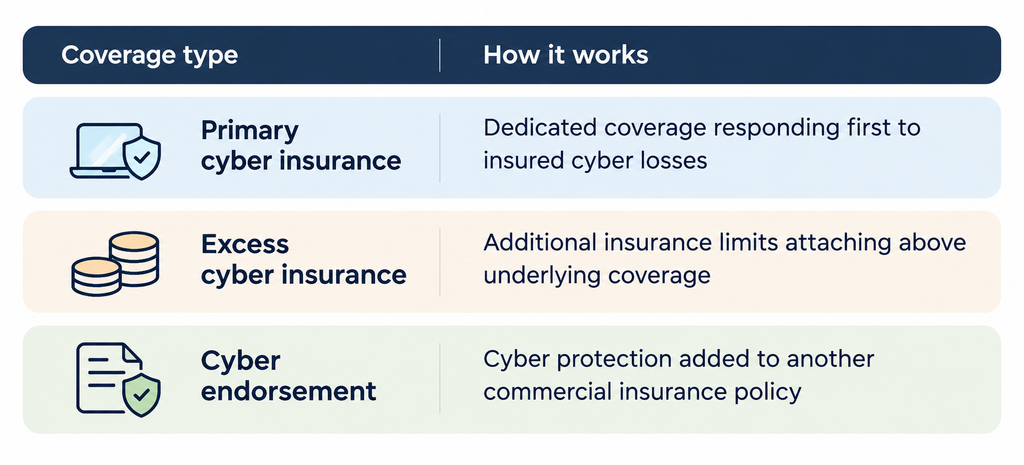
This distinction is particularly important when interpreting market growth.
A substantial increase in policy counts does not necessarily mean that businesses have purchased equivalent amounts of comprehensive cyber protection.
According to the NAIC, endorsements account for nearly two-thirds of domestic policies in force.
However, dedicated primary cyber insurance generates a much larger proportion of total cyber insurance premium.
This suggests that the market is serving different customer needs through different product structures.
Businesses purchasing cyber endorsements may be seeking limited protection against selected exposures, while organisations facing more complex risks may require dedicated primary and excess insurance programmes.
Most economic cyber losses remain uninsured
Despite growing insurance adoption, the report identifies a substantial gap between cyber-related economic losses and the amount protected by insurance.
The NAIC cites an estimate that only around 1% of global economic losses arising from cyber incidents are covered by insurance.
This is a global estimate, not a measurement of the percentage of American businesses holding cyber policies.
Nevertheless, it highlights the limited role insurance currently plays in absorbing the total financial consequences of cyber incidents worldwide.
Many small and medium-sized enterprises remain without cyber insurance.
Some businesses may lack awareness of available products, while others may struggle to assess their cyber exposure or determine what level of insurance is appropriate.
Coverage exclusions, limits and policy complexity can also influence purchasing decisions.
For insurance brokers and advisers, the protection gap presents an opportunity to help businesses understand cyber-related financial risks and evaluate suitable insurance options.
At the same time, insurers must avoid assuming that greater policy penetration automatically translates into adequate protection.
Artificial intelligence and third-party dependencies reshape cyber risk
The NAIC report identifies several developments influencing the cybersecurity environment.
Artificial intelligence is one of them.
AI tools can help cybercriminals create convincing phishing messages, manipulate documents and accelerate some stages of cyberattacks.
These technologies can also support legitimate cybersecurity activities, including threat detection, incident analysis and risk assessment.
The impact of AI therefore extends to both attackers and organisations seeking to strengthen their defences.
Another major concern is growing dependence on shared technology infrastructure.
Businesses increasingly rely on external cloud platforms, software providers, payment systems and technology vendors.
An incident affecting one widely used provider could disrupt numerous organisations simultaneously.
This creates what insurers call cyber accumulation risk.
Unlike an isolated incident involving one insured business, an accumulation event can generate claims across many policyholders from a common underlying cause.
The potential consequences extend beyond individual policies.
One event could affect several insurance portfolios and, depending on coverage, multiple lines of business.
For insurers and reinsurers, understanding shared technology dependencies is therefore important when assessing portfolio exposure and managing the potential concentration of losses.
What the NAIC findings mean for insurers and brokers
The report has several implications for insurance market participants.
For insurers, the combination of slower premium growth, increasing reported claims and a higher loss ratio reinforces the importance of underwriting discipline.
Risk assessment may need to place greater emphasis on organisations’ cybersecurity controls, incident response capabilities, backup arrangements and reliance on external technology providers.
For reinsurers, interconnected cyber risks remain particularly important because a single event could produce losses across numerous insurers.
Portfolio modelling and exposure management can help assess potential accumulation scenarios, although cyber risk modelling continues to face uncertainty.
Insurance brokers have a different responsibility.
As cyber products become more widespread, buyers need clear explanations of what their policies cover.
Standalone policies, excess coverage and endorsements should not be treated as interchangeable.
Particular attention may be required for business interruption, ransomware, social engineering, funds transfer fraud and incidents affecting outsourced technology providers.
Coverage for these events can differ considerably between insurers.
For corporate insurance buyers, the report reinforces the need to review cybersecurity and insurance as connected elements of risk management.
Insurance can provide financial support after certain covered incidents, but it cannot prevent attacks or replace effective security controls.
What comes next for the U.S. cyber insurance market?
The NAIC’s 2026 report shows that the U.S. cyber insurance market remains substantial and continues to attract more policyholders.
However, increasing claims, evolving cyber threats and continued pricing competition create important questions about the sustainability of current market conditions.
Future performance will depend on factors including claim frequency, severity, underwriting practices, security improvements and the extent of losses arising from interconnected technology systems.
The report does not establish that prices will rise, insurers will withdraw capacity or the market will become unprofitable.
Those outcomes remain uncertain.
What the findings do establish is that growth in cyber insurance adoption must be considered alongside the financial performance of the coverage being provided.
For insurers, brokers and businesses, the challenge is to make cyber insurance more accessible while ensuring that coverage remains appropriate, clearly understood and financially sustainable.