
The Insurance Regulatory and Development Authority of India (IRDAI) has introduced a new four-layer motor insurance framework for private cars and two-wheelers, effective 15 December 2026.
The changes aim to make insurance policies easier to understand by clearly separating compulsory protection from optional covers. Vehicle owners will be able to see the insurance protection they have selected and the premium charged for each section.
The framework was announced through circular IRDAI/CIR/MOT/10/2026, dated 2 November 2026, following directions issued by the Supreme Court in National Insurance Company Ltd. v. Smt. Thungala Dhana Laxmi & Others.
The regulator has directed general insurers carrying on motor insurance business to adopt uniform policy wordings, collect a completed customer option form and provide a Customer Information Sheet (CIS) at the point of sale.
Importantly, the introduction of four layers does not make every type of motor insurance cover compulsory.
What are the four layers of motor insurance?
Under the new structure, a private motor insurance policy will distinguish four coverage sections.
| Insurance layer | Status | Purpose |
|---|---|---|
| Third-party liability | Mandatory | Protection against covered legal liabilities to third parties |
| Legal liability to occupants or pillion riders | Optional | Specified legal liability for eligible passengers, pillion riders and employees |
| Personal accident | Mandatory and optional components | Compulsory owner-insured protection and additional optional accident covers |
| Own damage | Optional | Protection against covered loss or damage to the insured vehicle |
Each section serves a different purpose. Understanding these differences is particularly important when deciding whether a third-party-only policy provides sufficient protection.
Layer 1: Third-party liability insurance
Third-party liability insurance remains compulsory under Indian motor insurance requirements.
It provides protection against covered legal liabilities arising from accidents involving third parties, including eligible claims involving bodily injury, death or property damage.
This protection does not automatically cover damage to the policyholder’s own vehicle.
Motorists must continue to maintain the legally required third-party insurance even if they decide not to purchase optional protection.
Layer 2: Legal liability to occupants and pillion riders
The second layer provides optional protection against specified legal liabilities involving occupants of a private car or pillion riders on a two-wheeler.
The framework also refers to employees travelling in the insured vehicle.
This cover is intended to address eligible liabilities relating to people travelling in the vehicle, subject to the policy’s terms, exclusions and applicable requirements.
The number and categories of people covered are important. Vehicle owners should check whether particular passengers are eligible rather than assuming that everyone travelling in the vehicle is automatically protected.
This is a separate form of protection from personal accident insurance.
A legal liability policy responds to specified liabilities of the insured, whereas personal accident insurance provides benefits according to the insured person’s accident coverage.
Layer 3: Personal accident protection
The third layer combines mandatory and optional personal accident components.
The framework identifies compulsory personal accident protection for the owner-insured, subject to the applicable rules and eligibility requirements.
Vehicle owners may also choose additional personal accident protection for occupants, pillion riders or drivers other than the owner-driver.
Personal accident protection is different from ordinary medical insurance or own-damage motor insurance.
It generally responds to specified accident-related events according to the policy’s benefit structure, sum insured, exclusions and conditions.
Buyers should check who is insured, the insured amount and the events for which benefits are payable.
Layer 4: Own-damage insurance
Own-damage insurance covers specified loss or damage to the insured vehicle.
It remains optional under the four-layer framework.
Depending on policy terms, own-damage protection may respond to risks such as accidents, theft, fire and certain natural events.
It should not be assumed that all own-damage policies provide identical protection.
Deductibles, exclusions, insured declared value, depreciation conditions and optional add-ons can affect the amount payable following a claim.
IRDAI has retained insurers’ flexibility to develop own-damage products and determine their pricing in line with market conditions, subject to regulatory requirements.
What changes when buying or renewing motor insurance?
One of the most practical changes concerns how insurers must present coverage options.
From 15 December 2026, policies issued under the new framework must follow the prescribed structure and uniform wordings.
Vehicle owners must be provided with a customer option form explaining the available sections.
Buyers can indicate their choices by selecting the relevant options, whether they purchase insurance online or offline.
A duly completed option form must become part of the policy documentation.
Insurers must also provide a Customer Information Sheet at the point of sale.
This creates a clearer record of the protection selected and helps reduce uncertainty about whether optional covers were purchased.
Another important requirement is the separate disclosure of premiums.
Instead of relying only on an overall premium figure, the policy schedule must show the actual coverage offered and the premium charged against each applicable section.
For policyholders comparing insurance products, this can make it easier to understand where their money is being spent.
Can existing policyholders add passenger liability cover?
Yes. The circular specifically addresses existing motor insurance policies.
Policyholders who want to add Section II legal liability protection for occupants or pillion riders during an active policy period may do so by paying an additional premium.
However, the additional cover must be purchased from the insurer that issued the existing third-party insurance policy.
The new protection begins only from the date and time specified in the endorsement issued by that insurer.
An endorsement is an official modification to an existing insurance contract.
IRDAI has clarified that the existing third-party insurance policy does not need to be cancelled merely to obtain this additional protection.
Vehicle owners should nevertheless confirm the exact coverage, premium and effective date before relying on an endorsement.
Will motor insurance premiums increase after December 15?
The new rules introduce clearer premium disclosure, but they do not establish a universal premium increase or reduction.
Insurance costs will continue to depend on factors such as the vehicle, selected covers, applicable tariff or regulatory requirements, insurer pricing and the policy’s terms.
Optional insurance sections may increase the total premium when selected.
Conversely, choosing not to purchase a particular optional cover may reduce the number of protections included in the policy, but can also leave the policyholder exposed to losses that the omitted cover would otherwise have addressed.
A lower quoted premium is therefore not necessarily a better insurance proposition.
Vehicle owners should compare both the price and the actual coverage offered.
The new framework’s main contribution is the clearer separation of coverages and their associated premiums, rather than a promise that insurance will become cheaper.
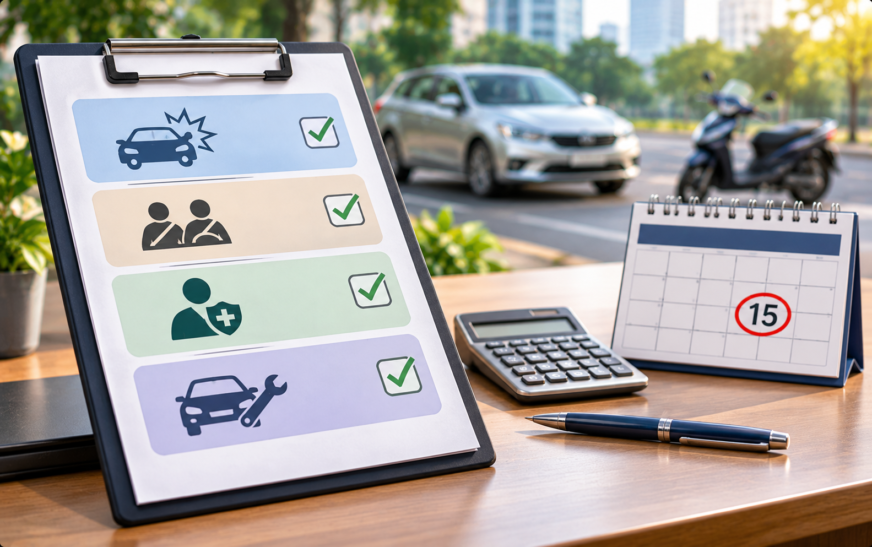
Five things car and bike owners should check before renewal
With the new structure approaching, motorists can use the following checklist when reviewing their next motor insurance policy.
1. Confirm mandatory protection. Check that the policy satisfies applicable third-party liability requirements and the relevant compulsory personal accident provisions.
2. Review passenger and pillion-rider protection. Determine whether optional legal liability cover is relevant to how the vehicle is used, and carefully review who is covered.
3. Check personal accident benefits. Confirm the insured persons, sums insured, covered events and applicable exclusions.
4. Assess the need for own-damage insurance. Consider the vehicle’s value, financial exposure and the potential cost of repairing or replacing it following an uninsured loss.
5. Read the option form, policy schedule and Customer Information Sheet. Check that the selected covers match the premium breakdown and that no important protection has been omitted or misunderstood.
These checks are relevant whether insurance is purchased through an insurer, agent, broker or digital platform.
What must insurers implement before December 15?
The circular places several implementation responsibilities on general insurers offering the affected motor insurance products.
Insurers must adopt the four-layer structure and uniform wordings, incorporate the mandatory option form into the purchase journey and issue the Customer Information Sheet.
Their policy schedules must clearly identify coverage and premiums for each section.
These changes may require insurers to update product documentation, sales processes, online interfaces, intermediary journeys and policy administration systems.
That operational impact is an industry implication of the circular rather than a separate set of expressly prescribed technical requirements.
IRDAI has also directed insurers to integrate the four-layer motor insurance structure with Bima Sugam so that the relevant products are available through the platform from the effective date.
Bima Sugam is intended to serve as a digital insurance marketplace, although the direction should not be treated as proof that every insurer’s integration has already been completed.
What remains unchanged under the new framework?
The most important existing principle remains intact: compulsory motor insurance protection cannot simply be replaced by optional cover.
Own-damage insurance is still not universally mandatory, and purchasing optional protections remains a matter of the customer’s needs and applicable policy terms.
Existing policies are not described in the circular as automatically cancelled or replaced on the implementation date.
The circular does, however, expressly provide a route for existing third-party policyholders to add optional occupant liability cover during the policy period.
It also does not establish a standard premium for every optional section.
What happens from 15 December 2026?
All policies issued under the affected private vehicle categories from 15 December 2026 must conform to the new four-layer framework.
For insurers, this means implementing the prescribed policy structure, documentation and customer selection process.
For policyholders, the practical benefit should be greater clarity about the protection available, the choices made and the premium paid for each section.
The success of the reform will ultimately depend on how clearly insurers explain the options and how accurately the selected protection is reflected in the final policy.
Motor insurance buyers should use the new disclosures to understand their coverage rather than choosing a policy solely on the basis of its headline premium.