
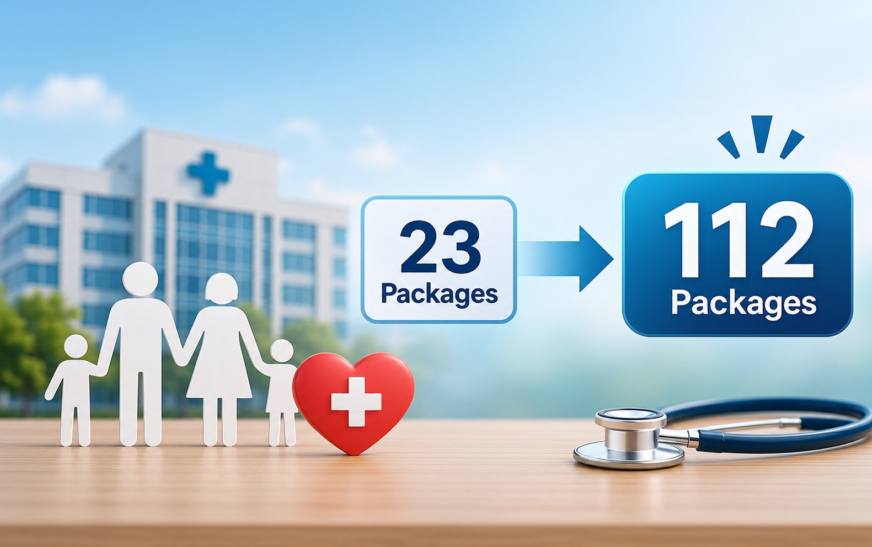
The National Health Authority (NHA) is considering raising the number of Ayushman Bharat PM-JAY public hospital packages, the treatments reserved for public hospitals, from 23 to 112, adding 89 medical and surgical packages to the existing list.
The proposal aims to bring commonly required treatments closer to beneficiaries while directing more scheme reimbursements towards government healthcare facilities. It particularly targets Community Health Centres (CHCs) and Sub-Divisional Hospitals (SDHs).
According to a PTI report published by The Economic Times on 18 November 2026, the NHA has sought feedback from state health agencies before finalising the proposed changes. The expansion concerns packages reserved for public hospitals, not 89 entirely new treatments being added to AB-PMJAY’s overall coverage.
More common treatments proposed as public hospital packages
The proposed 89 additional packages cover medical conditions and procedures that government facilities are considered capable of managing with their existing infrastructure and clinical staff.
According to NHA sources cited by PTI, the medical conditions include severe anaemia, accelerated hypertension, acute bronchitis, diarrhoea, dysentery, gastroenteritis, urinary tract infections, renal colic, acute febrile illnesses and certain diabetes complications.
The proposed surgical and diagnostic services include hysterectomy, circumcision, biopsy, hydrocele and haemorrhoid treatment, and screening for diabetic retinopathy and glaucoma.
A senior NHA official told PTI that the objective was to ensure patients would not need to travel long distances for treatment available at government hospitals closer to home.
Since 2019, 23 packages covering obstetrics, gynaecology and mental health have been reserved for public healthcare facilities under the scheme.
Several states have independently reserved additional packages based on local hospital capabilities. The new proposal would extend the public hospital reservation approach at the national level, subject to state-level adjustments.
Higher utilisation could strengthen hospital reimbursements
The proposal also seeks to make greater use of existing government healthcare infrastructure.
Under AB-PMJAY, empanelled public hospitals receive reimbursements for providing cashless treatment to eligible beneficiaries. Increasing treatment volumes at these facilities would generate additional reimbursement income where qualifying services are delivered.
NHA officials said the funds can support infrastructure upgrades, medical equipment, medicines, consumables, operational expenses and additional healthcare personnel.
This creates a potential financial incentive for government hospitals to provide more routine medical and surgical care locally, rather than referring patients to larger hospitals.
For patients, the intended benefit is better access to treatment near their homes, particularly in rural and underserved areas. Actual availability would depend on the capabilities and specialist staffing of individual facilities.
The proposal would not require every government hospital to offer all 112 reserved packages. States would retain flexibility to reduce the list according to available infrastructure, specialists and other essential resources.
For hospitals and state health agencies, implementation would therefore involve matching the reserved-package list to local treatment capacity and reimbursement arrangements.
According to the PTI report, the NHA issued an office memorandum dated 13 October 2026 asking state health agencies to submit their suggestions by 25 November 2026.
The revised arrangement is tentatively proposed to take effect on 1 December 2026, after consideration of state feedback. No final approval or implementation notification has been independently confirmed.
The proposal forms part of continuing efforts to strengthen public healthcare delivery under Ayushman Bharat. Readers can follow related developments through MYINSURANCE360’s Regulation & Policy coverage and Health Insurance updates.