
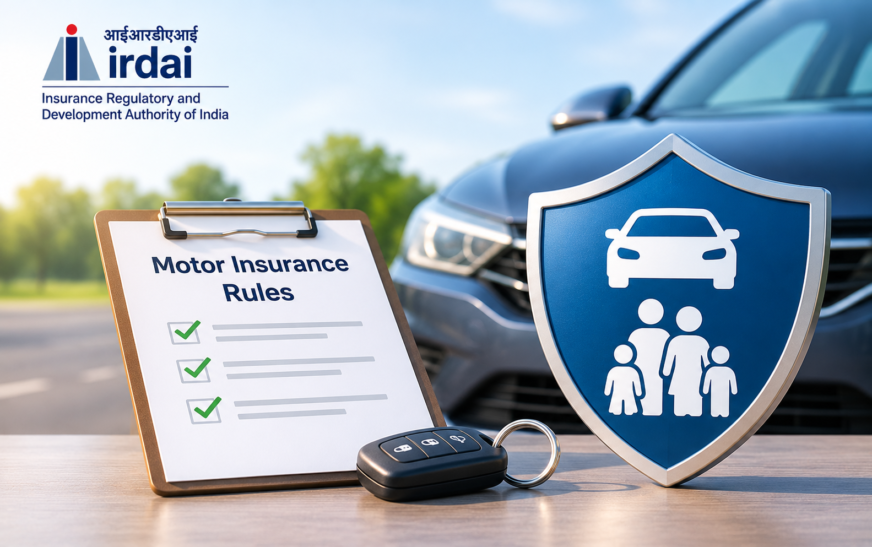
India’s new four-layer motor insurance rules take effect on 15 December 2026, requiring private car and two-wheeler policies to distinguish compulsory protection from optional cover for passengers, personal accidents and vehicle damage.
For motorists travelling with their families, the most important question is whether their policy protects the people inside the vehicle. The Insurance Regulatory and Development Authority of India’s 2 November circular requires insurers to make those choices explicit.
The regulator’s framework follows Supreme Court directions in National Insurance Company Ltd. v. Smt. Thungala Dhana Laxmi & Others. It introduces uniform wording and a mandatory customer option form to clarify what vehicle owners are purchasing.
Four sections in the new motor insurance rules
The framework separates private motor insurance into four sections.
Section I covers third-party liability, which remains mandatory under motor insurance requirements. It addresses the insured’s legal liability to third parties under the applicable policy and law.
Section II covers legal liability to occupants or pillion riders, including employees of the insured. This section is optional and requires the customer to select the cover.
Section III covers personal accidents. It includes mandatory personal accident protection for the owner-insured, subject to applicable requirements, and optional protection for occupants, pillion riders and other drivers.
Section IV covers loss of or damage to the insured vehicle. Own-damage protection remains optional, with insurers retaining flexibility over its pricing and coverage features.
The distinction between Sections II and III matters because they address different risks. Occupant-liability insurance responds to specified legal liabilities, while personal accident insurance provides benefits under the relevant accident-cover terms.
Buying one does not automatically establish that the other is included.
Why family members should check the policy wording
Mint’s reporting identifies an exclusion affecting the vehicle owner’s immediate family under the standard occupant-liability wording. The reported exclusion refers to parents, spouses and children.
This raises a practical concern for families who regularly travel together. Selecting an optional passenger-liability section should not be treated as confirmation that every family member receives personal accident protection.
A vehicle owner travelling with a spouse and children should therefore check which people are covered under the occupant-liability section and whether additional personal accident benefits apply.
The same distinction applies to two-wheelers carrying pillion riders. The policy schedule, definitions, exclusions and selected optional benefits determine the protection purchased.
The new structure is intended to make these differences easier to identify. It does not mean that existing policies automatically lose all passenger or family protection when the framework takes effect.
Existing policyholders can add occupant cover
IRDAI allows existing policyholders to purchase Section II occupant-liability protection during the currency of their third-party insurance.
The additional cover must be obtained from the insurer that issued the third-party policy. The customer pays an additional premium, and coverage begins at the date and time specified in the endorsement.
IRDAI states: “No existing Motor Third Party Insurance need to be cancelled” for choosing additional covers.
For policies issued from 15 December 2026, insurers must obtain a completed customer option form and provide a Customer Information Sheet. The policy schedule must also disclose the cover and premium charged for each section.
These requirements give customers and insurance advisers a clearer basis for checking whether a policy includes passenger liability, personal accident benefits and own-damage protection.
The regulator has also directed insurers to integrate the structure with Bima Sugam from the same effective date.
MYINSURANCE360 previously reported the introduction of the four-layer motor insurance framework and the wider legal questions surrounding motor third-party coverage.
For vehicle owners, the immediate task is to check the selected covers and the people eligible for benefits. The new policy format makes those choices more visible, but the protection still depends on the policy terms.