
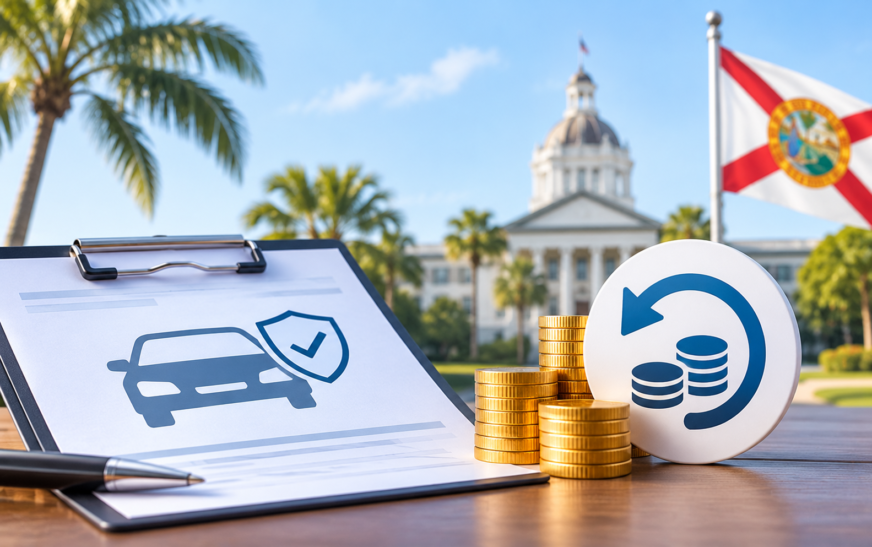
Florida has ordered three motor insurers to return US$122.68 million in excess underwriting profits to eligible policyholders following a regulatory review of their results for 2023–2025.
The Florida Office of Insurance Regulation (OIR) announced the action on 19 November 2026. Liberty Mutual Personal Insurance, Security National Insurance and Cimarron Insurance must provide cash refunds or credits towards policy renewals.
The regulator’s announcement identifies the three companies and their respective amounts. The orders require the funds to be returned; they do not mean every eligible policyholder has already received payment.
The latest action brings excess-profit refunds announced by Florida regulators during 2026 to more than US$168 million.
Three insurers face $122.7 million in auto insurance refunds
Liberty Mutual Personal Insurance Company has been directed to return US$73,139,740, the largest amount among the three insurers.
Security National Insurance Company must return US$48,628,580, while Cimarron Insurance Inc. must provide US$908,149 to applicable policyholders.
Together, the amounts total US$122,676,469. Liberty Mutual accounts for almost 60% of that sum, followed by Security National at approximately 40%.
The refunds arise from underwriting results over the 2023, 2024 and 2025 calendar-accident years.
Florida Insurance Commissioner Mike Yaworsky said the regulator would continue examining the profits generated by motor insurers.
“I encourage other companies to review their books too,” Yaworsky said in the OIR announcement.
The commissioner also thanked the companies for supplying the necessary information to the regulator.
The announcement did not specify how many policyholders qualify for the latest refunds or provide an average amount per customer.
Individual refunds will depend on each insurer’s eligible policyholders and the statutory allocation of excess profits.
How Florida’s excess-profits law determines eligibility
The refund orders arise under Florida Statute 627.066, which prohibits excessive underwriting profits from private passenger motor insurance.
The statute requires insurer groups to submit annual Florida motor insurance financial data to OIR. The regulator examines earned premiums, claims costs, expenses and anticipated underwriting profits.
Excess profits arise when an insurer group’s combined underwriting gain over the three most recent calendar-accident years exceeds its anticipated underwriting profit plus 5% of earned premiums.
The calculation therefore compares actual underwriting performance with the profit allowance reflected in the insurer’s rates.
Once excessive profits are established, OIR can order the amount returned after providing the insurer an opportunity for a hearing.
The law includes an exception where an insurer demonstrates that the refund would cause financial impairment or insolvency.
Eligibility is linked to the final year in the three-year reporting period.
For the latest 2023–2025 review, qualifying recipients are voluntary private passenger auto policyholders of record on 31 December 2025.
Refunds are distributed proportionately according to earned premiums for that final compilation year.
Holding a Florida driving licence or purchasing insurance from another company does not independently establish eligibility.
The law concerns private passenger auto insurance rather than every type of motor or commercial vehicle policy.
Cash refunds, renewal credits and payment deadlines
Florida law permits insurers to return excess profits through cash payments or credits against future insurance purchases.
If an insurer selects cash refunds, those payments must be completed within 60 days after entry of the final regulatory order.
Renewal credits operate differently. Insurers apply them to renewal premium notices sent more than 60 calendar days after the final order.
If a policyholder becomes entitled to a renewal credit but subsequently cancels or allows the policy to terminate, the insurer must make a cash refund within 60 days of termination.
OIR’s announcement said the three insurers would process refunds or credits within the coming 60 days, with payments expected during the holiday period.
The precise timing therefore depends on the applicable final order, the selected payment method and the policyholder’s circumstances.
Insurers must also attempt to locate customers whose refund checks are returned as undeliverable.
Unclaimed funds must be handled under Florida’s abandoned property requirements, rather than simply retained by the insurer.
The statutory process also requires companies to certify completion of refunds or renewal credits to the regulator.
The November orders follow an earlier requirement for Infinity Auto Insurance to return approximately US$46.25 million in excess profits.
That separate action brought the total refunds announced during 2026 to more than US$168 million when combined with the latest three orders.
The new payments represent a return of underwriting profits above Florida’s statutory threshold, not a permanent reduction in future premium rates.
MYINSURANCE360 previously covered Florida’s approval of a 7% USAA auto insurance rate cut, a separate pricing development. Further regulatory and market developments appear in its Regulation & Policy and Industry & Market coverage.