
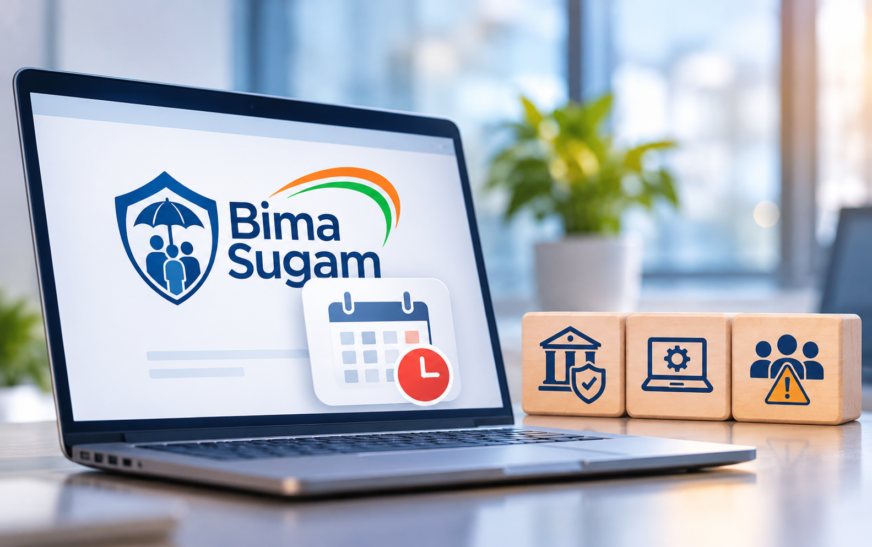
The Bima Sugam launch has been deferred after a planned 23 November 2026 beta rollout of its motor insurance offering, Bima Vahan, encountered insurer readiness and product-integration gaps.
The postponement follows discussions with the Insurance Regulatory and Development Authority of India (IRDAI), according to reports published on 24 November. A rollout by the end of December is now being considered, although no revised date has been confirmed.
According to Business Standard’s report, the delay reflects gaps in participating insurers’ product offerings and preparations for a new four-layer motor insurance framework.
The setback comes ahead of a separate regulatory deadline on 15 December, when insurers must begin issuing motor policies under the revised structure and complete the corresponding Bima Sugam integration.
Insurer readiness gaps delay Bima Sugam launch
Bima Vahan was expected to become the first product offering on the Bima Sugam digital insurance marketplace.
Nine general insurers had been identified for the initial beta, including SBI General Insurance, ICICI Lombard, HDFC ERGO, New India Assurance and Go Digit.
However, a review of the proposed launch found gaps in product readiness and coverage availability.
Some participating insurers were not prepared to offer cover for new two-wheelers. Others had yet to make standalone third-party insurance available through the platform.
Three-year and five-year policy options were also unavailable from some insurers where those products were applicable.
The initial offering was designed around new vehicles. Insurance for older vehicles and policy renewals was not yet part of the proposed beta scope.
Business Standard reported that only nine of the 27 insurers expected to participate were ready to offer products at that stage.
This limited participation raised concerns about launching a marketplace that could not yet provide a broad or consistent selection of motor insurance products.
The Insurance Reporter also reported the postponement, citing discussions with the insurance regulator.
The problem is therefore not simply whether the central platform can accept transactions. Participating insurers must also connect their systems and make suitable policy options available.
Four-layer motor insurance rules add December deadline
The delay comes as insurers prepare to implement IRDAI’s revised motor insurance requirements.
Under Circular IRDAI/CIR/MOT/10/2026, issued on 2 November, private car and two-wheeler insurance policies must follow a four-layer structure from 15 December 2026.
The framework separates cover into third-party liability, legal liability to occupants or pillion riders, personal accident protection and own damage.
Third-party liability remains mandatory. Other components contain mandatory or optional elements according to the policyholder and coverage requirements.
The circular also introduces uniform policy wordings, a customer option form and a mandatory Customer Information Sheet.
Insurers must present the available sections and premiums clearly, enabling customers to understand which protections they are purchasing.
IRDAI has directed insurers to complete integration of the four-layer structure with Bima Sugam by the same effective date.
That requirement creates an additional implementation task for insurers already working to connect their products with the marketplace.
Motor products must reflect the revised coverage structure, customer choices and required policy documentation.
For participating insurers, system integration and regulatory product readiness therefore need to progress together.
The reported delay does not itself amend the 15 December deadline.
Marketplace regulations remain in force despite rollout delay
Bima Sugam’s regulatory framework predates the latest postponement.
IRDAI notified the Bima Sugam Insurance Electronic Marketplace Regulations, 2024 in March 2024.
Those regulations provide for a digital insurance marketplace designed to support policy purchases, servicing, claims settlement and grievance redressal.
They also establish a not-for-profit company structure, with ownership distributed across life, general and health insurers.
The operational platform is being developed through Bima Sugam India Federation, with Protean eGov Technologies appointed as its technology partner.
The project’s broader objective is to provide a common digital infrastructure connecting insurers, intermediaries and customers.
In a September interview with Business Standard, IRDAI Chairman Ajay Seth described Bima Sugam as a commission-neutral institution operating through nominal fees.
Bima Sugam was first proposed in 2022 and has subsequently missed several anticipated launch windows.
The latest delay leaves insurers working towards the December motor integration deadline while the public beta launch remains uncertain.
For customers, the intended benefits of comparing and purchasing motor insurance through a common marketplace will depend on when the platform becomes available and how many insurers can offer complete products.
The immediate issue for the industry is operational readiness. A marketplace supported by multiple insurers requires consistent product availability, functioning integrations and compliance with the applicable policy requirements.
The reported end-December launch expectation remains provisional. IRDAI and the platform’s operators have not announced a firm replacement date in the available reports.
MYINSURANCE360 previously examined IRDAI’s new motor insurance rules and their implications for policy structure. Related developments are covered under Technology & InsurTech and Regulation & Policy.